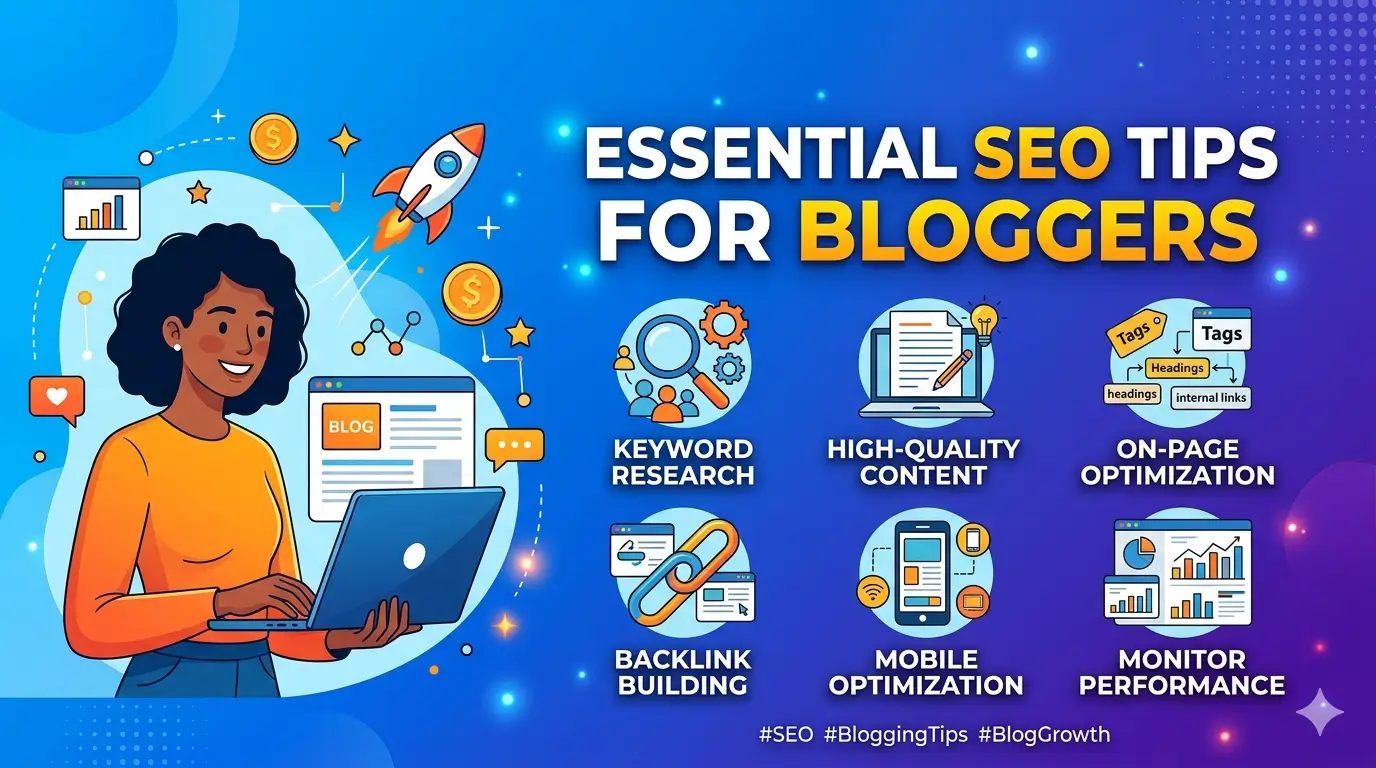
You’ve been writing. You’ve been publishing. And Google still acts like your blog doesn’t exist. Here’s how to fix that — for good.
There’s a moment every blogger knows painfully well. You hit publish on a post you spent hours crafting. You refresh your analytics. You wait. And then… nothing. A trickle of readers, maybe a few from social media, then silence.
Here’s the truth nobody in the blogging industry wants to say out loud: writing great content is no longer enough. In 2026, the bloggers who win on Google are the ones who understand how search engines think — and write for both humans and algorithms at the same time.
These SEO tips for bloggers aren’t recycled advice from 2019. This is what’s working right now, updated for how Google, AI-driven search, and reader behavior have fundamentally changed.
Let’s get into it.
SEO Tips for Bloggers: The 2026 Playbook That Actually Works
You’ve been writing. You’ve been publishing. And Google still acts like your blog doesn’t exist. Here’s how to fix that — for good.
There’s a moment every blogger knows painfully well. You hit publish on a post you spent hours crafting. You refresh your analytics. You wait. And then… nothing. A trickle of readers, maybe a few from social media, then silence.
Here’s the truth nobody in the blogging industry wants to say out loud: writing great content is no longer enough. In 2026, the bloggers who win on Google are the ones who understand how search engines think — and write for both humans and algorithms at the same time.
These SEO tips for bloggers aren’t recycled advice from 2019. This is what’s working right now, updated for how Google, AI-driven search, and reader behavior have fundamentally changed.
Let’s get into it.
1. Stop Chasing Keywords. Start Chasing Intent.

Keyword research is still the foundation of any successful SEO strategy. But here’s where most bloggers go wrong: they obsess over search volume and forget about search intent.
Search intent is the why behind a query. When someone types “best running shoes,” are they looking to buy today, or are they researching? That distinction determines everything — your content format, your headline, your call to action, and your monetization strategy.
There are four types of search intent you need to know:
- Informational – The reader wants to learn something. (“How does SEO work?”)
- Navigational – They’re looking for a specific site or page. (“Ahrefs login”)
- Commercial investigation – They’re comparing options before buying. (“Ahrefs vs. Semrush”)
- Transactional – They’re ready to act. (“Buy Ahrefs plan”)
Before you write a single word, identify your post’s intent. Then match your content format to that intent. A listicle works for informational posts. A detailed comparison works for commercial investigation. Mismatching these is one of the fastest ways to kill your rankings before you even start.
Pro tip: Look at the top 5 results for your target keyword on Google. What format are they using? Blog post, video, product page, FAQ? Google is showing you exactly what searchers want. Match it.
2. Do Keyword Research Like a Professional (Not a Hobbyist)
Only 50% of bloggers regularly perform keyword research. That’s a staggering competitive advantage sitting right in front of you.
Here’s the smart approach:
Go long-tail, always. Instead of targeting “blogging tips” (insanely competitive), target “blogging tips for beginners in 2026” or “how to monetize a blog with under 1,000 visitors.” Long-tail keywords have lower competition, clearer intent, and higher conversion rates. They’re your fastest path to organic traffic.
Mine the “People Also Ask” section. Every time you search Google, that little box of related questions is a goldmine. Each question is a real search query from a real person. Target them in your H2s and H3s, and you’ll start earning featured snippet placements — the holy grail of organic visibility.
Use the right tools. Free tools like Google Search Console, Google Keyword Planner, and Google Trends are underrated. Paid tools like Ahrefs, Semrush, and Ubersuggest add deeper data. Even without a budget, you can find low-competition, high-intent keywords if you know where to look.
Cluster your content. Instead of writing one random post about a keyword, build a content cluster: a comprehensive pillar post supported by several related posts that link back to it. This signals topical authority to Google and dramatically boosts the rankings of every post in the cluster.
3. Nail Your On-Page SEO — Every Single Time
On-page SEO is the set of optimizations you control directly on your post. This is where a huge portion of ranking power lives, and it’s where most bloggers leave massive gains on the table.
Here’s your on-page SEO checklist for every post:
Title tag: Your title does two jobs — it ranks the page and convinces people to click. Include your primary keyword near the beginning. Keep it under 60 characters or Google will truncate it. And in 2026, inject personality. Titles with a benefit, number, or emotional hook outperform dry, keyword-stuffed ones. “7 SEO Tips for Bloggers That Tripled My Traffic in 90 Days” will always beat “SEO Tips for Bloggers.”
Meta description: This 150-160 character snippet won’t directly move your rankings, but it dramatically affects your click-through rate (CTR) — which does influence rankings. Include your focus keyword, a clear benefit, and a call to action. Make it feel human, not robotic.
URL structure: Keep it short and descriptive. /seo-tips-for-bloggers/ beats /2026/04/10/the-ultimate-guide-to-seo-tips-for-bloggers-that-will-help-you-rank/ every single time. Remove stop words. Include your primary keyword.
H1, H2, H3 hierarchy: Use only one H1 per post (your title). Use H2s for main sections and H3s for subsections. Naturally weave in your focus keyword and related keywords like search engine optimization, organic traffic, SERP rankings, content strategy, and on-page optimization. Don’t force it — if it reads awkwardly, rewrite it.
First 100 words: Put your focus keyword in the opening paragraph. This tells Google immediately what your post is about. It also reassures readers they’re in the right place, reducing bounce rate.
Internal linking: Every post you publish should link to at least 2-3 other relevant posts on your blog. This builds a connective web that helps Google crawl your site, distributes link equity, and keeps readers engaged longer. Longer session duration is a powerful ranking signal.
4. Write for Humans First. Then Optimize for Google.
Here’s where a lot of “SEO advice” goes badly wrong. People read it and start writing for search engines — stiff, keyword-heavy, robotic content that makes readers bounce in 8 seconds.
Google’s algorithms are now extraordinarily sophisticated at evaluating content quality and user experience. High bounce rates, low time-on-page, and poor engagement metrics all hurt your rankings.
The golden rule: Write for humans first. Optimize for Google second.
In practice, that means:
Short paragraphs. Three to four lines max. Big walls of text are reader repellent. White space is your friend.
Strong hooks. You have about 7 seconds to convince a reader to stay. Your intro needs to validate their problem, promise a solution, and create enough curiosity that they can’t stop reading.
Scannable structure. The average blog post is read in under a minute — which means most people are skimming, not reading every word. Use descriptive subheadings, bold key phrases, and numbered lists to make your content easy to navigate. A reader who can skim your post and understand the value is more likely to go back and read it properly.
Conversational tone. Write like you talk. Avoid jargon unless your audience demands it. Ask questions. Use “you” and “I.” The most shared blog posts feel like they were written by a trusted friend who happens to be an expert.
Depth over frequency. In 2026, shallow 500-word posts are a liability. Comprehensive posts of 1,500 words or more consistently outperform thin content in search results. But length for the sake of length is equally useless. Every paragraph needs to earn its place.
5. Technical SEO: The Invisible Foundation
You can write the best blog post on the internet, and if your technical SEO is broken, nobody will ever see it. Google literally cannot rank what it cannot crawl and index.
These are the technical SEO fundamentals every blogger needs to have locked in:
Page speed. Slow sites kill rankings and destroy user experience. Compress your images before uploading (tools like TinyPNG do this for free). Use a caching plugin if you’re on WordPress. Consider upgrading your hosting if your site takes more than 2-3 seconds to load. A one-second delay can reduce conversions by up to 7%.
Mobile-first design. Over 60% of global web traffic now comes from mobile devices, and Google evaluates your site primarily on its mobile version. If your blog isn’t fully responsive, you are actively losing rankings. Test your site on Google’s Mobile-Friendly Test — it’s free.
Core Web Vitals. Google uses a set of performance metrics called Core Web Vitals to evaluate user experience. The three you need to know are Largest Contentful Paint (LCP), which measures loading speed; Cumulative Layout Shift (CLS), which measures visual stability; and Interaction to Next Paint (INP), which measures responsiveness. These are real ranking factors. Check yours in Google Search Console.
HTTPS. If your blog doesn’t have an SSL certificate, fix this today. HTTPS is both a trust signal for readers and a ranking factor for Google. Most hosting providers offer it for free.
XML sitemap and robots.txt. Make sure Google knows your site exists and can crawl it efficiently. Submit your sitemap in Google Search Console. Double-check that your robots.txt file isn’t accidentally blocking important pages.
Image alt text. Every image on your blog should have descriptive alt text. This helps visually impaired readers, and it helps Google understand what your images depict — an often-overlooked ranking signal.
6. Build E-E-A-T: The New Authority Currency
Google’s quality rater guidelines hinge on four factors: Experience, Expertise, Authoritativeness, and Trustworthiness — collectively known as E-E-A-T. In 2026, this isn’t just a checklist item. It’s the single most important competitive differentiator for bloggers.
Ask yourself: does your blog demonstrate that a real, qualified human is behind it? Here’s how to build E-E-A-T:
- Create a detailed About page that establishes your credentials and story.
- Add author bios to every post with links to your social profiles and any published work.
- Cite your sources. Link to authoritative external sources (government sites, academic papers, industry reports). It builds trust with readers and signals credibility to Google.
- Get mentioned. Guest post on authoritative blogs in your niche, appear on podcasts, earn press mentions. Every external reference to your name or brand is a trust signal.
- Update your content. Stale content is a credibility killer. Refresh old posts with new data, updated advice, and current examples. A “last updated” timestamp signals to Google that your content is actively maintained.
7. Link Building: Still the Most Powerful Ranking Factor
Backlinks — links from other websites pointing to yours — remain one of the most powerful ranking signals Google uses. One quality link from a high-authority site can move your rankings more than dozens of on-page optimizations.
But link building in 2026 has changed. Spammy link schemes will get you penalized, not promoted. Here’s what actually works:
Create linkable assets. Original research, comprehensive data studies, free tools, and definitive guides all attract natural backlinks because other bloggers and journalists want to cite authoritative sources. Even a simple survey of 100 people in your niche produces citable data that earns links.
Guest posting. Writing for other established blogs in your niche earns you a backlink and exposes your content to a new, relevant audience. Quality over quantity — one guest post on a high-authority site beats ten posts on low-traffic blogs.
The skyscraper technique. Find a high-ranking post in your niche, create something significantly better (more comprehensive, more current, better designed), and reach out to sites linking to the original. It’s methodical, but it works.
Internal links count too. Don’t overlook your internal link structure. A strong internal linking strategy distributes page authority throughout your site and helps every post rank better.
8. Optimize for AI Search — Without Abandoning Human Readers
This is the newest dimension of the SEO tips for bloggers conversation, and it matters. AI-powered search results from Google’s AI Overviews, ChatGPT search, Perplexity, and others are now a real traffic source — and a real threat to traditional blog traffic if you ignore them.
Here’s how to stay visible in the age of AI search:
Answer questions directly and clearly. AI search engines pull concise, authoritative answers. Structure your posts so that key answers appear in the first sentence after an H2, followed by supporting detail. This format feeds AI summaries and earns featured snippets.
Use FAQ sections. End your posts with a FAQ section that targets “People Also Ask” queries in your niche. These are frequently pulled into AI-generated answers.
Implement schema markup. Adding structured data (FAQ schema, HowTo schema, Article schema) helps both Google and AI engines understand your content and display it in enriched formats. If you’re on WordPress, plugins like Rank Math and Yoast make this easy.
Be the original source. AI engines prefer to cite primary sources. Publish original insights, original data, and original opinions. Being the first to say something specific in your niche makes you the reference point.
9. Consistency Beats Perfection
Here’s the uncomfortable truth: the best SEO strategy in the world fails without consistency. Blogs that publish regularly — even if imperfectly — consistently outperform blogs that publish brilliantly but infrequently.
Search engines reward fresh content. Each post you publish is a new asset that can attract traffic for months or years. Think of your content library as compound interest: the returns are modest at first, then exponential.
Build a content calendar. Set a publishing cadence you can sustain — whether that’s once a week or three times a month. Stick to it. The bloggers who win in search aren’t always the most talented. They’re the most consistent.
10. Track, Measure, and Iterate
The final SEO tip for bloggers is the one most often skipped: measure everything, and let the data lead.
Set up Google Search Console (free). It shows you exactly which queries are driving impressions and clicks, which posts are ranking, and where you’re losing ground. Set up Google Analytics 4 (also free) to track user behavior — time on page, bounce rate, top-performing content, and traffic sources.
Review your data monthly. Double down on what’s working. Diagnose what isn’t. Update underperforming posts before creating new ones — refreshing existing content is often faster and more effective than starting from scratch.
The Bottom Line
The bloggers who will dominate search results in 2026 and beyond are the ones who treat SEO as a craft, not a checkbox. These SEO tips for bloggers aren’t tricks or hacks. They’re the fundamental disciplines that compound over time into serious, sustainable organic traffic.
Start with keyword intent. Nail your on-page elements. Build your authority. Fix your technical foundation. Write for human beings. And show up consistently.
Do those things, and Google will notice. Your readers will notice. And your analytics will tell a very different story than the one they’re telling today.
Now go publish something worth ranking.