Picture tomorrow morning: a timer, a short task list, and 90 minutes with nothing else open. That is the whole setup for the daily routine to make money online laid out below. It is built for beginners who have already paid for programs that talked a lot and showed little, so every block here has a task, an order and a time limit.

One honest note first. No routine can promise you a date for $15,000 a month, and this one doesn’t. What it gives you is the daily work that builds the things that can produce that income: published content, a growing email list, and links to offers that pay you. Let’s go.
Start With the Number: How $15,000 a Month Breaks Down Into Daily Work
$15,000 a month is $500 a day across a 30-day month. Affiliate income doesn’t arrive in neat daily amounts, though. It arrives in sales and recurring payments, so the useful question is how many of those you need.
Here is the arithmetic, using made-up round numbers so you can swap in the real figures for any offer you promote:
- An offer that pays $500 per sale needs 30 sales a month.
- An offer that pays $1,500 per sale needs 10 sales a month.
- An offer that pays $50 a month in recurring commission needs 300 active customers.
The higher the payout per sale, the fewer buyers you need, which is why the idea behind high-ticket affiliate marketing for beginners deserves a look before you pick what to promote. Fewer sales means fewer readers who have to find you, trust you and click.
Those readers come from three places, and they match the three blocks below. Content brings people in, the email list keeps them in contact with you, and the offers turn some of them into commissions. The daily routine is 90 minutes split across those three jobs: 45 minutes for content, 25 for your list, 20 for offers.
Block One: Publish Something Built Around What People Actually Search For
Start the day with the hardest task while your head is clear. That is writing something a stranger can find.
Content that gets found is written around a phrase people type into a search box. “How to make your first affiliate commission” is a search phrase. “Thoughts on my journey” is not, because nobody searches for it. If you need a method for choosing phrases, planning content around what people actually search for walks through one.
Here is how the 45 minutes breaks down:

- Minutes 0 to 5: Open this week’s topic list and take the next phrase on it. You choose the list in advance (see the weekly rhythm below), so this step involves no deciding.
- Minutes 5 to 35: Write one article that answers that one question. Put the phrase in the title and the opening paragraph, then use headings that answer the follow-up questions a reader would ask next.
- Minutes 35 to 45: Read it once out loud or at a slow pace, cut anything that doesn’t help the reader, fix the title and publish.
Publishing matters more than polishing. An article sitting in drafts gets no search traffic and teaches you nothing. A published one can be improved next week when you know how it performs.
Keep the article’s job narrow. It should answer one question for one kind of reader, and the best ones fit your pillars: reviews, beginner guides, and tools and gear for making money online.
Block Two: Grow the Email List While Nobody Is Watching
A new site has few visitors, and most of them leave and never come back. An email list lets you reach the ones who liked what they read. At the start, this block feels like talking to an empty room, and you do it anyway, because a small list built early is much easier to grow than one you start later.
Spend 25 minutes like this:
- 10 minutes: Improve the sign-up offer on today’s article. Give readers a reason to subscribe that matches the topic, such as a checklist or a short guide that continues what they just read. A generic “join my newsletter” box converts worse than a specific offer attached to a specific article. If you haven’t built a list yet, building your first email list for free covers the starting setup.
- 10 minutes: Write or schedule one email. Keep it short. Share one useful point from the article you just published, and tell the reader what to do with it. Pick a sending schedule you can keep, whether that is once a week or more, and keep it.
- 5 minutes: Answer replies and messages. Every reply tells you what your readers are stuck on, and that is a ready-made topic for next week’s list.
Don’t spend this block choosing between email platforms. Pick one that fits your budget, learn it as you use it, and stay with it.
Block Three: Point Your Content at Offers That Pay You
Content with no offer attached earns nothing, however many people read it. This block takes 20 minutes, and the work is placing the right link in front of the right reader at the moment they would want it.
Work through these in order:
- Choose one placement. Either add a link to the article you just published, or go back to an older article and add one there.
- Match the offer to the reader’s problem. If the article explains how to build a site, a hosting or training offer fits. If it reviews a tool, link the tool. A link a reader has no use for gets ignored and costs you trust.
- Say it is an affiliate link. Add a clear disclosure on any page with affiliate links. It is the honest thing to do, and many programs and countries require it.
- Write one sentence about who the offer suits and who it doesn’t. Readers who see that you describe an offer fairly are more willing to click.
Your own course belongs in this block as well. Once you have one, it deserves a link wherever a reader’s question leads to it. There is more on the whole subject in how to monetize your content as a beginner.
Revisiting older articles is a good use of this block. A page published a month ago is already indexed, and a link added to it starts working with traffic it may already have.
The Weekly Rhythm: What Each Day Is For
Every day uses the same three blocks, but each day has one main purpose so that you never open your laptop wondering what to do.
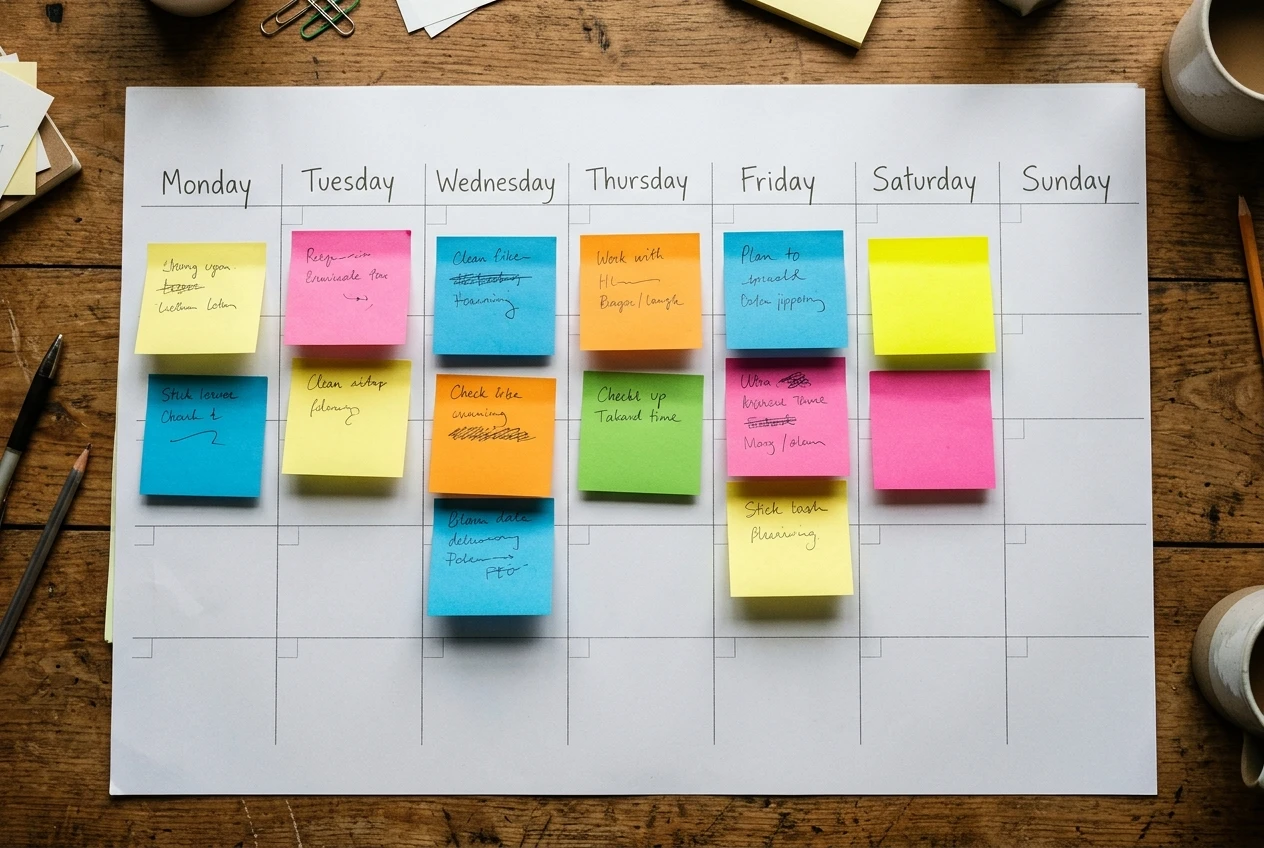
- Monday: Plan. Spend the content block choosing the week’s search phrases. Pick three, write them in a list, and put the first one in order for Tuesday. Then do blocks two and three as usual.
- Tuesday to Thursday: Publish. One article per morning, taken from the list. This gives you three new pages a week, which is a pace a beginner can hold.
- Friday: Improve and check. Use the content block to revise the weakest article from earlier in the week, then run the 15-minute scoreboard below.
- Saturday: Optional catch-up. If a day was missed, make it up here. If nothing was missed, use the time to add offer links to older articles or write a longer email.
- Sunday: Off. A routine you can keep for a year beats a punishing one you drop in week three.
Three articles a week adds up to about a dozen a month, and a site with a dozen well-targeted articles can be seen and measured. A site with two articles can’t tell you much of anything.
The 15-Minute Scoreboard: The Few Numbers Worth Checking
Checking stats all day feels productive and teaches you very little. Check them once a week, on Friday, and keep the list short. Allow 15 minutes.
- Articles published this week. The target is the number from your plan. If you missed it, find out why before you do anything else.
- New email subscribers. Note which article they signed up on, since that tells you what kind of offer works.
- Clicks on your affiliate links. If your tools show clicks, note which pages get them. Pages with traffic and no clicks need a better-placed link.
- Search impressions and visits per page. If your site tools report them, see which phrases are starting to bring people in and which articles still get none.
- Commissions or sales. Write the number down even when it is zero, so you can see it change.
For each number, ask one question: what is one change to make next week? Move a link, rewrite a title, try a different sign-up offer. Then write the change down and make it. Numbers you read and don’t act on are just a hobby.
What to Cut From Your Day If Other Programs Left You Stuck
If you have tried other programs and still earn nothing, the usual cause is where your time went, not how much of it you spent. These are the things worth removing from the 90 minutes:

- Watching lessons without publishing. Training helps when you apply it the same day. Watch one lesson, then do the block it relates to.
- Buying another course before finishing the first. A new program offers a fresh start and the same amount of work. Finish the routine you already have for a full 90 days before you judge it.
- Changing niche every few weeks. Search traffic builds on pages that stay up and keep getting found. Starting over resets that.
- Shopping for tools. You need a place to publish, a way to collect emails and a way to see your numbers. The 5 affiliate marketing tools you actually need lists them, and everything else can wait until you earn.
- Fiddling with design. A logo and colors can be done in an afternoon. They won’t bring a single reader to your site.
- Scrolling social media for “research”. Search phrases give you topics. A feed gives you distraction.
Each of these feels like work and produces nothing a reader can find, click or buy. Cutting them frees up the time the three blocks need.
Your First Block Starts Tomorrow Morning
Tonight, spend ten minutes on preparation so tomorrow starts without decisions. Write down one search phrase a beginner might type, such as a question about starting affiliate marketing. Open a blank document with that phrase as the title, set a 90-minute timer and put your phone in another room.
Tomorrow, run the blocks in order: 45 minutes publishing, 25 minutes on your list, 20 minutes placing an offer. When the timer ends, stop and close the laptop. Repeat it the next day. Whether you stay with the routine for the first week decides far more than how good your first article is.
If you want to see how this routine fits into a longer timeline, the 6-month plan to chase $15k a month online lays out the work month by month.
Ready to run this routine with real training and a real platform behind you? Join Wealthy Affiliate through my link and block out your first 90-minute session for tomorrow morning.