
Passive Income Is Just Assets That Compound, and Here’s the 3-Part Engine That Keeps Paying After You Log Off
Most people who go looking for passive income end up working harder than they did before. They post more, DM more and chase more clicks, and the money stops the day they do. If you have already tried a few make-money-online programs and your bank account still shows zero, the cause is probably what you were building, not how hard you tried.
This guide gives you a simple way to sort your week, a three-part engine to build, and a plan for moving your hours toward work that keeps paying after you log off. Let’s get you fired up and pointed at the right work.
Why “Passive” Income Stops the Second You Stop Posting
Take a social post with an affiliate link. It gets attention while it is fresh, then it slides down everyone’s feed and the clicks dry up. To keep earning, you have to post again tomorrow. That is active promotion: income that depends on you repeating the effort.
An asset works differently. A well-targeted article can keep showing up in search results long after you wrote it. An email list keeps giving you a way to reach people who already know you. An offer that is set up properly can sell while you are away from your desk. Each one adds to the last, because every new article feeds the list and every new subscriber is a possible buyer.
So the useful question about any task is: does this still produce results next month if I never touch it again? If yes, you are building something. If no, you are renting attention, and the rent comes due every day. If you want to go deeper on a single asset, how to build a digital asset covers that. This article is about how all the pieces work together.
How to Build Passive Income Online
Learning how to build passive income online comes down to three parts that depend on each other:
- Search-driven content brings in new readers without you chasing them.
- An email list captures those readers so they do not disappear after one visit.
- An offer gives those readers something to buy, so the traffic and the list turn into money.
Take one away and the system leaks. Content with no list loses most visitors for good. A list with no offer is a hobby. An offer with no traffic has nobody to sell to. Build all three, in that order, and you have something that earns while you sleep.
Passive income is also front-loaded. You put in the hours first and collect later. That is why the next step matters so much: before you build anything new, find out where your hours are going now.
The 10-Minute Sort: Tag Every Task in Your Week as Rent or Own
Grab a pen or open a spreadsheet and list everything you did last week to build your business. Be specific: “posted in two groups,” “wrote a 1,500-word article,” “tweaked my logo,” “replied to comments.” Then tag each line with one letter.
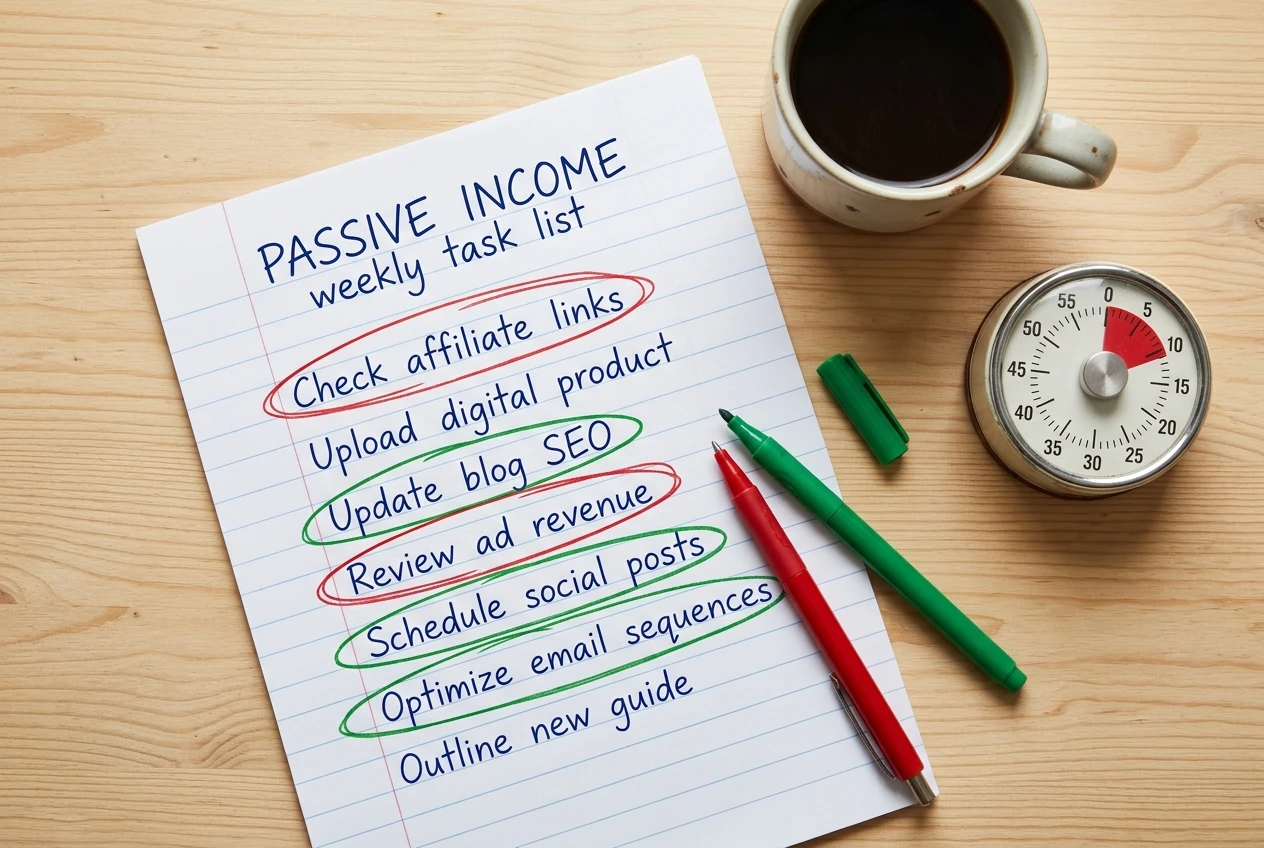
- R (rent): the result lasts only while you keep doing the task. Social posts, group promotion, daily outreach and live pitching are examples.
- O (own): the result keeps working after you finish. Published articles, updates to existing articles, a welcome email sequence, a saved lead magnet and a set-up offer page are examples.
Some tasks are borderline. Use the same test as before: if you stop doing it, does the result stay? Writing an article stays. Posting a link to that article in a group fades. Updating an old article to fit what searchers want now stays.
Now add up the hours in each column. Most beginners find that nearly everything is R, and that is useful to know. The goal is to move the balance over the coming weeks, so that more of your time goes into things that keep working without you.
Some tasks fit neither column, such as tweaking a logo or reorganizing your files. Tag them O only if they feed the engine, and be honest about that. Busywork feels productive and produces nothing, so cut it.
Engine Part 1: Search-Driven Content That Keeps Bringing Readers While You Sleep
People type questions into search engines every minute of the day. When your article answers one of those questions better than the other pages do, readers can find you with no promotion from you. That is why search content is the first part of the engine.
Start with real keywords that carry search intent, meaning phrases a person types when they want an answer or a solution. “How to make your first affiliate commission” is a question someone is asking. “Motivation tips” is vague. Choose one specific phrase per article, then write the piece to fully satisfy whoever typed it.
A simple routine for each article:
- Pick one keyword and decide what the searcher wants to walk away with.
- Answer that in the first few paragraphs, then go deeper below.
- Link to your related articles so readers keep moving through your site.
- Come back later to improve it if readers are leaving early or the topic has changed.
If you want the full method for choosing topics, how to plan content around what people actually search for walks through it step by step. One article will not change your life. Twenty well-chosen ones become a steady source of readers.
Engine Part 2: An Email List That Turns One-Time Visitors Into Repeat Buyers

Here is the problem with search traffic alone: most visitors read your article once and leave. If they have no reason to come back, you spent all that effort on a single visit. An email list lets you reach those readers again, and people usually need to see an offer more than once before they buy.
Building the list takes three pieces:
- A free resource worth giving your email for. A checklist, a short guide or a template that solves one specific problem for your reader.
- A sign-up form on the articles that attract your best readers.
- A welcome sequence you write once. A few emails that introduce you, deliver value and mention your offer.
Writing that sequence is an O task. It sends itself to every new subscriber, whether you are online or not. If you have not started, how to build an email list for free shows you how to get set up quickly, and the best email marketing platform for beginners can help you choose where to host it.
Engine Part 3: The Offer That Gets Paid on Autopilot
Traffic and a list need somewhere to go. The offer is where your readers can say yes. You have three main choices, and you only need one to begin.
Affiliate offers. You recommend a product and earn a commission when someone buys through your link. This is the lowest-effort place to start because someone else handles the product, checkout and support. Your job is to match the offer to the reader’s problem.
Recurring commissions. Some programs pay again each time a customer renews. One referral can keep paying for as long as the customer stays, which fits the idea of an asset better than a one-time commission. This list of high ticket affiliate programs with recurring commissions is a good place to look.
Your own course. You build it once, and each sale after that costs you no extra production time. It takes more upfront work, but you keep the whole sale and set the terms. You do not have to be an expert to start, only a step or two ahead of your reader. Creating a digital course when you are not an expert explains how.
Pick one, link it from your best articles, and mention it in your welcome emails. Add a second offer later, once the first is working.
The Honest Truth: Passive Income Is Front-Loaded Work, So Here’s What the First 90 Days Look Like
Nobody can promise you a date when the money starts, and anyone who does is selling something. Search engines need time to find and rank new pages, so the early weeks can feel quiet. That quiet is normal. What you control is the work you put in, so here is a plan to follow.
Days 1 to 30: lay the base.
- Run the 10-minute sort and write down your R-to-O balance.
- Get your site set up and choose your first offer.
- Pick your first batch of keywords and publish your first articles on a steady schedule.
Days 31 to 60: add the list.
- Keep publishing on the same schedule.
- Create your free resource, add the sign-up form and write your welcome sequence.
- Link your offer from the articles that fit it best.
Days 61 to 90: improve what exists.
- Look at which articles are getting visitors and which are not.
- Update the weaker ones and write follow-ups on topics that are getting attention.
- Re-run the sort and compare it to day one.
If you hit a wall along the way, why you are still not making money online covers the common stall points. And if you are wondering whether your project is a business or a hobby, a 30-minute profit audit can show you where you stand.
How to Shift Your Hours From Chasing to Compounding Without Dropping Your Income to Zero
If you earn something today from active promotion, do not drop it overnight. The goal is to move hours over gradually while the new assets get established.
- Start with your sort. Take your R column and find the tasks that bring in the least for the most effort. Cut those first.
- Move a slice of the freed hours. Put them into one O task, such as writing one more article or finishing the welcome sequence.
- Keep the rent tasks that actually pay until an asset replaces that income. Each week, look at whether the O work is bringing in readers and subscribers. As it does, shift more hours across.
- Block the O work on your calendar first. Rent tasks are urgent and noisy and will fill your day if you let them. Protect the building time before anything else.
If you want a model for structuring your days, a daily routine to make money online shows one way to block your time.
Passive Income Generating Tools
You do not need a long list of software. Each tool below supports one part of the engine:
- A website and hosting. The home for your search content. Wealthy Affiliate lets you build your site and learn the process in the same place, which keeps early setup simple.
- A keyword research tool. For finding phrases people actually search, so each article has a clear target.
- An email platform. To collect subscribers and send your welcome sequence automatically.
- Your affiliate programs or a course checkout. Where the offer lives and gets paid.
- A simple spreadsheet. For the rent-or-own sort and for tracking what you publish.
For a more detailed breakdown of what is worth paying for and what can wait, see the affiliate marketing tools you actually need.
Frequently Asked Questions
Is passive income really passive?
Not at the start. You do the work up front, and later the assets keep producing with much less effort from you. Articles still need occasional updates and your list needs the occasional new email, but the daily chasing stops.
How long does it take to build passive income online?
It varies, and nobody can give you an honest guarantee. Search content takes time to be found and ranked. The best thing you can do is publish consistently and keep improving what you have.
Which part of the engine should I build first?
Start with search content, because it creates the readers the other two parts depend on. Add the email list once you have a few articles live, and pick your offer early so you can link it as you go.
Can I do this alongside a job?
Yes. The work is made of small, repeatable tasks like writing an article or updating one. Block the time on your calendar and protect it.
What if I have no audience yet?
Search content is built for exactly that. You do not need followers, because readers find your articles through the questions they type into a search engine.
Final Thoughts
Passive income comes from owning things that keep working after you stop. Sort your week, build the three parts, and keep moving your hours from renting attention toward building assets. The first articles are the hardest because you are working before there is any proof, and each one after that adds to what is already there.
Ready to build the engine instead of just chasing the next sale? Open Wealthy Affiliate and start your first compounding asset today: pick one keyword, publish one article, and let it start working for you.