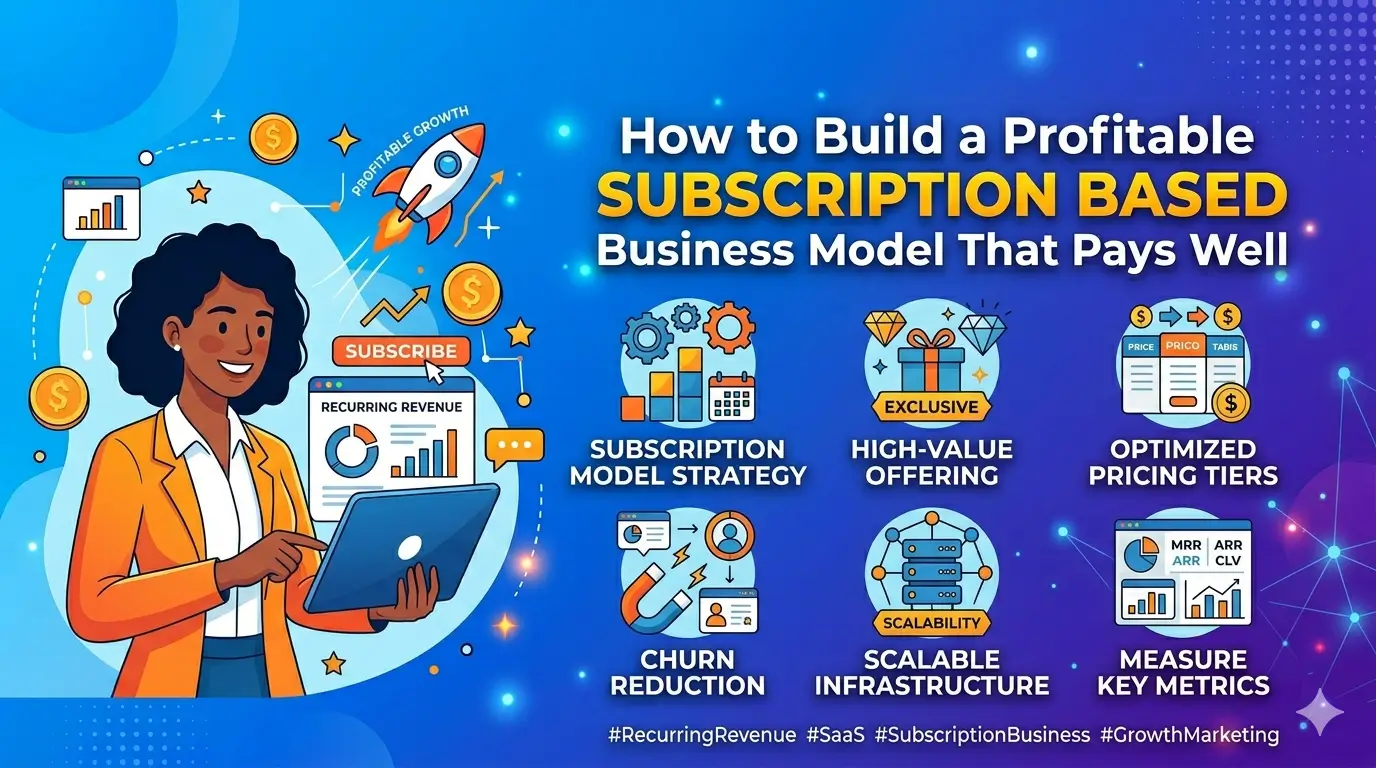
The smartest entrepreneurs aren’t chasing one-time sales anymore. They’re building recurring revenue machines — and you can too.
The Business Model That Turned Ordinary Companies Into Empires
Netflix. Spotify. Salesforce. Duolingo. Amazon Prime.
What do they all have in common?
They cracked the code on the subscription based business model — and they never looked back.
Here’s the uncomfortable truth most business gurus won’t tell you: selling something once is exhausting. You wake up every Monday morning at zero. You hustle for leads. You close deals. You repeat. The feast-or-famine cycle is real, it’s brutal, and it’s entirely avoidable.
A well-executed subscription business model flips that equation entirely. Instead of resetting to zero, you build on a growing foundation of predictable, recurring revenue. Every month that passes makes your business more valuable, more stable, and frankly — more sellable.
This guide is for the entrepreneur, creator, SaaS founder, or freelancer who’s tired of trading time for money and wants to build something that compounds. Whether you’re starting from scratch or pivoting an existing business, this is the most practical breakdown of subscription-based business strategy you’ll find anywhere.
What Is a Subscription Based Business Model (And Why It Dominates Every Industry Right Now)?
A subscription based business model is a revenue structure in which customers pay a recurring fee — weekly, monthly, or annually — in exchange for continuous access to a product, service, content, or community.
This isn’t new. Newspapers and milk delivery services were running subscription models a century ago. But the digital economy turbocharged the concept beyond recognition.
Today, the global subscription economy is valued at over $3 trillion and growing at roughly 15–20% annually. Consumers now subscribe to everything from software and streaming to razors, dog food, mental health coaching, and online education.
The real magic? Predictability. Investors pay premium multiples for subscription businesses. Acquirers love them. Employees want to work for them. That’s because recurring revenue is the closest thing to a crystal ball that business has ever produced.
The 6 Core Types of Subscription Business Models
Before you build, you need to choose your model. Each has a distinct profit profile, customer relationship, and growth curve.
1. SaaS (Software as a Service)
The gold standard. Think Slack, HubSpot, Zoom. You build software once and sell access repeatedly. Margins can exceed 80%. The challenge is customer acquisition cost and churn management.
2. Content & Community Subscriptions
Substack newsletters, Patreon memberships, paid podcasts, online courses with recurring cohorts. These are creator-economy powerhouses with low overhead and deeply loyal audiences.
3. Product Subscription Boxes
Dollar Shave Club, HelloFresh, Birchbox. Physical goods delivered on a schedule. Margins are thinner, but brand loyalty and lifetime customer value (LCV) can be exceptional.
4. Service Retainers
Agencies, consultants, and freelancers who charge a flat monthly fee for ongoing work. This is often the fastest path to subscription income for solo operators.
5. Access & Membership Models
Costco. LinkedIn Premium. Professional associations. You’re selling access to a network, a marketplace, a resource library, or a community of peers.
6. Usage-Based / Metered Subscriptions
AWS. Twilio. OpenAI’s API. Customers pay based on consumption, with a subscription floor. These scale beautifully with enterprise clients.
Why Most Subscription Businesses Fail in Year One (And How to Avoid It)
Let’s be real. The subscription model isn’t a magic wand. Plenty of founders slap a “subscribe” button on a mediocre product and wonder why no one stays.
Here’s where they go wrong:
❌ They Underestimate Churn
Customer churn rate — the percentage of subscribers who cancel each month — is the silent killer of subscription businesses. A 10% monthly churn rate means you lose your entire customer base in less than a year. You need to obsess over churn before you obsess over growth.
The benchmark to beat: Under 5% monthly churn for consumer subscriptions. Under 2% for B2B SaaS.
❌ They Price for Acquisition, Not Lifetime Value
Cheap introductory pricing attracts tire-kickers. You want subscribers who see your value clearly enough to pay full price — and stay for years. Customer lifetime value (CLV) always needs to exceed your customer acquisition cost (CAC) by a ratio of at least 3:1.
❌ They Skip the Value Ladder
Successful subscription businesses rarely lead with a subscription. They warm prospects up through free content, a freemium tier, a one-time purchase, or a low-cost trial — then convert to recurring billing. Skipping this ladder burns your audience before they’re ready to commit.
❌ They Ignore Onboarding
The first 14 days of a subscription are everything. If your new subscriber doesn’t experience a clear “aha moment” fast, they’ll ghost you before the second billing cycle. A frictionless, value-packed onboarding sequence is non-negotiable.
How to Build a Subscription Based Business Model From Scratch: The 7-Step Playbook
Step 1: Nail Your Niche and Validate Demand
The biggest mistake aspiring subscription founders make is building first and validating second.
Before writing a single line of code or printing a single box, answer these questions:
- Who exactly is your subscriber? Go beyond demographics. What keeps them up at night? What goal are they obsessively chasing?
- What ongoing problem does your subscription solve? The keyword here is ongoing. A subscription must solve a recurring need, not a one-time problem.
- Is anyone already paying for something similar? If yes — great. That’s market validation, not competition to fear.
Use tools like Google Trends, Reddit communities, Quora threads, and social listening platforms to find the language your target market uses to describe their pain. That language will become your copywriting gold.
Pro tip: Run a pre-launch waitlist with a simple landing page and paid traffic before you build anything. If people won’t hand over their email address, they definitely won’t hand over their credit card.
Step 2: Design a Pricing Strategy That Maximizes Revenue Without Killing Conversions
Pricing is the most underrated lever in any subscription based business model.
Here’s a framework that consistently outperforms:
Anchor with Three Tiers:
- Basic — stripped-down, entry-level access. Designed to convert fence-sitters and reduce barrier to entry.
- Standard (Your Hero Tier) — the one you actually want most customers on. Best value. Most prominently displayed. 70–80% of your revenue should come from here.
- Premium / Enterprise — for power users and teams. Higher price, white-glove features, unlocks your highest CLV customers.
Annual vs. Monthly Pricing: Always offer an annual plan at a 15–20% discount. Annual subscribers churn at dramatically lower rates and dramatically improve your cash flow. Push hard for annual commitments.
The Freemium Question: Freemium works when your product has viral or network effects (Slack, Dropbox, Zoom). It’s a liability when you don’t have the scale or margins to subsidize free users indefinitely. Evaluate carefully before going freemium.
Step 3: Engineer Your Core Value Proposition Around Retention, Not Just Acquisition
Most businesses market for acquisition. Elite subscription businesses design for retention from day one.
Ask yourself: What would make canceling this subscription feel genuinely painful?
The answer to that question is your stickiness strategy. It could be:
- Accumulated data or history (MyFitnessPal — your workout history lives there)
- Community and relationships (a Slack community or mastermind group)
- Integrations and workflow dependency (HubSpot connected to your entire sales stack)
- Personalization that improves over time (Spotify’s Discover Weekly)
- Sunk cost and credential value (certifications, badges, career relevance)
Build stickiness in. Don’t bolt it on after your churn rate starts alarming you.
Step 4: Build a Recurring Revenue Engine With Multiple Acquisition Channels
You need customers. Here’s how the best subscription businesses find them consistently:
Content Marketing & SEO Long-form, search-optimized content that solves real problems is the highest-ROI acquisition channel for subscription businesses over a 12–24 month horizon. Build a content moat. Own your niche’s Google real estate.
Email Marketing Your email list is your most valuable subscription asset — even more valuable than your subscriber count. A warm, engaged list converts to paid subscriptions at rates that dwarf cold traffic. Build it from day one.
Referral Programs Word-of-mouth is turbocharged by financial incentive. Dropbox grew 3,900% in 15 months largely through a referral program. Give your best subscribers a reason to evangelize.
Partnerships and Integrations Strategic partnerships with complementary services put you in front of pre-qualified audiences. If you’re a project management tool, integrate with Slack. If you’re a nutrition subscription box, partner with fitness apps.
Paid Acquisition Facebook and Instagram ads, Google Search campaigns, and YouTube pre-rolls can work brilliantly for subscription businesses — but only once you know your CLV and can tolerate a 3–6 month payback period on CAC.
Step 5: Obsess Over the Metrics That Actually Matter
You cannot manage what you don’t measure. These are the key performance indicators (KPIs) every subscription business must track:
| Metric | What It Tells You | Target |
|---|---|---|
| MRR (Monthly Recurring Revenue) | Your revenue heartbeat | Grow 10–20% MoM in early stage |
| ARR (Annual Recurring Revenue) | Annualized business scale | Key for investor conversations |
| Churn Rate | Subscriber retention health | <5% monthly (consumer), <2% (B2B) |
| CLV (Customer Lifetime Value) | Total revenue per subscriber | CLV ≥ 3x CAC |
| CAC (Customer Acquisition Cost) | Cost to win each subscriber | Know this cold |
| Net Revenue Retention (NRR) | Expansion revenue minus churn | >100% is world-class |
| Trial-to-Paid Conversion Rate | Funnel effectiveness | 15–25% is a solid benchmark |
| Average Revenue Per User (ARPU) | Revenue density | Grow through upsells |
If your Net Revenue Retention (NRR) is above 100%, congratulations — your business grows even if you never sign another new customer. That’s the holy grail.
Step 6: Build Revenue Expansion Into Your Model
The most profitable subscription businesses don’t just retain customers — they expand revenue from existing subscribers over time. This is called expansion MRR, and it’s the mechanism behind some of the greatest business success stories in recent history.
Tactics for expansion revenue:
- Upselling — move subscribers from Basic to Standard, Standard to Premium
- Cross-selling — offer adjacent products or add-ons (“Would you like to add our analytics dashboard?”)
- Seat-based pricing — charge per user, so your revenue grows as your customers’ teams grow
- Usage-based overages — charge for consumption above the base tier
- Annual upgrade incentives — reward monthly subscribers who commit to annual plans
Done well, your existing subscriber base becomes a revenue growth engine in its own right.
Step 7: Create a Systematic Churn Reduction Program
Churn is inevitable. Managing it systematically is what separates the businesses that compound from the ones that plateau.
Proactive Churn Prevention:
- Identify at-risk subscribers early using engagement signals (login frequency, feature usage, support tickets)
- Trigger automated “win-back” email sequences before someone cancels
- Offer proactive check-in calls for high-value accounts
Reactive Churn Reduction (The “Save” Flow): When someone clicks “Cancel,” don’t just let them leave. Deploy a structured save flow:
- Ask why they’re canceling (use a dropdown — this data is gold)
- Offer a pause option (“Take a 30-day break instead of canceling”)
- Offer a downgrade path to a lower tier
- Provide a retention offer (one month free, a discount, a bonus)
Even recovering 20–30% of would-be cancellations dramatically changes your growth trajectory.
The Subscription Business Model Profit Formula
Let’s talk numbers. Here’s the formula that determines whether your subscription business is truly profitable:
Monthly Profit = (ARPU × Total Active Subscribers) − (COGS + CAC Amortized + Operating Expenses)
To make this model lucrative — not just revenue-positive — you need to:
- Keep gross margins high. SaaS businesses target 70–85% gross margin. Service businesses should target 50–65%. Product subscription boxes are viable at 30–50% if CLV is long enough.
- Reduce CAC payback period. The faster you recoup your acquisition cost, the faster you can reinvest in growth. Sub-6-month CAC payback is excellent.
- Increase ARPU over time. Don’t let your price stagnate. Raise prices for new subscribers annually. Introduce premium tiers. Add value that justifies expansion.
- Keep subscribers longer. Every month a subscriber stays is pure margin improvement, since your CAC is already sunk. A subscriber who stays 24 months vs. 6 months is worth 4x as much — at nearly zero additional acquisition cost.
Real-World Examples of Subscription Based Business Models Done Right
🎵 Spotify — The Freemium Flywheel
Spotify’s genius: the free tier is deliberately frustrating enough to push serious listeners to Premium — but enjoyable enough to keep them in the ecosystem. Their freemium-to-premium conversion funnel is studied in business schools worldwide. The lesson: freemium can work if you design the friction carefully.
📦 Dollar Shave Club — The Disruption Play
DSC launched with a $12M acquisition offer rejected in favor of building to a $1 billion Unilever acquisition. Their subscription box model disrupted a category dominated by Gillette by leading with personality, convenience, and radically lower prices. The lesson: in commoditized markets, brand and convenience win.
📊 Salesforce — The B2B SaaS Pioneer
Salesforce normalized the idea that enterprise software could be rented, not owned. Their subscription model created network effects, deep CRM data lock-in, and a partner ecosystem that makes switching costs prohibitive. The lesson: build switching costs in early.
✍️ Substack — The Creator Economy Bet
Substack took the newsletter — one of the oldest content formats — and built a subscription monetization layer on top of it. Writers like Heather Cox Richardson earn millions annually from their subscriber bases. The lesson: you don’t need a novel product. You need a clear value delivery mechanism and an audience that trusts you.
Is a Subscription Based Business Model Right for You?
Ask yourself these five questions honestly:
- Does my product or service solve an ongoing need? (Not a one-time fix)
- Can I deliver consistent, improving value month after month?
- Is my target customer accustomed to paying for subscriptions in this category?
- Can I acquire customers at a cost that my CLV can support?
- Am I prepared to prioritize customer success as a core business function?
If you answered yes to four or five of these — you’re ready.
If you answered no to most — don’t abandon the idea. Rethink the product-market fit, the pricing model, or the customer segment until the yeses come naturally.
The Bottom Line: Why the Subscription Economy Rewards the Patient and Punishes the Impatient
Here’s the counterintuitive truth about building a profitable subscription based business model: it rewards patience in ways that almost no other business model does.
In year one, your revenue is modest. Your churn feels discouraging. Your CAC feels high. You’re questioning everything.
In year three, if you’ve executed well — if you’ve controlled churn, invested in content, built a product your subscribers genuinely love — something remarkable happens. Your MRR compounds. Your CAC efficiency improves. Your NRR crosses 100%. Word-of-mouth kicks in.
You stop feeling like you’re pushing a boulder uphill.
The boulder starts rolling on its own.
That’s the subscription model at its finest. Not a get-rich-quick scheme — a get-wealthy-systematically architecture that rewards the builders who are willing to play the long game.
The best time to start was five years ago.
The second-best time is right now.
Found this valuable? Share it with a founder who needs to hear it. And if you’re building a subscription business, drop your biggest challenge in the comments — I read every one.